The historical distinction
Twenty years ago, the difference was clear:
An answering service picked up your phone when you couldn't, took a message, and faxed or emailed it to you. They didn't book appointments, didn't qualify work, didn't have access to your calendar. The transaction was: 'capture the call, route the message.'
A virtual receptionist acted more like a real receptionist working remotely. They answered in your business name, knew your hours, your services, and your pricing. They could book appointments on your calendar and warm-transfer urgent calls.
In 2026, the line has blurred
Most modern services do both. Smith.ai, Ruby, AnswerConnect, AnswerForce — they all answer in your business name, qualify the call, book appointments, and route messages. The marketing terms have collapsed.
The remaining differences are in depth of integration, scripting flexibility, and pricing model. A 'virtual receptionist' service typically charges more per call/minute and offers richer scripting; an 'answering service' might charge less for a thinner intake.
For trade shops, this distinction matters less than people make it sound. What matters more: can the person (or AI) on the phone actually qualify a trade-specific call?
Forget the category label. The real question is whether the voice on the phone can qualify a trade-specific call.
What trade shops actually need
Forget the category label. The real questions for a trade shop are:
1. Does the service understand your trade? A general-purpose receptionist can read a script. A trade-fluent service knows that 'half my house is out' is usually a tripped breaker (walk through the reset before dispatching), that 'the AC won't kick on' on a 95° day is an emergency dispatch, that 'I want a quote on a roof' after a hail storm is an estimate visit, not a service call.
2. Can it book on your dispatch board? ServiceTitan, Housecall Pro, Jobber, FieldEdge, AccuLynx — your dispatch software is the source of truth. The answering service that pushes the booked job into your dispatch board automatically saves you 5 minutes per call. The one that messages you a free-text summary you have to re-type costs you that 5 minutes per call, which adds up.
3. How does it bill? Per-call, per-minute, or flat. Per-minute services punish you during surges. Per-call services punish you for spam volume. Flat-rate is most predictable but locks you into a tier you might not need.
4. What's the after-hours story? Most trade shops get 30–50% of calls outside 9–5. The service that's 24/7 by default at no surcharge is meaningfully better than the one that bills 1.5× for evenings and weekends.
5. How fast can you change the script? When your service-call fee changes, when you stop taking commercial work, when you add EV charger installs — how fast does the answering service update? The good ones are same-day; the slow ones are 5–7 business days.
The category we're in
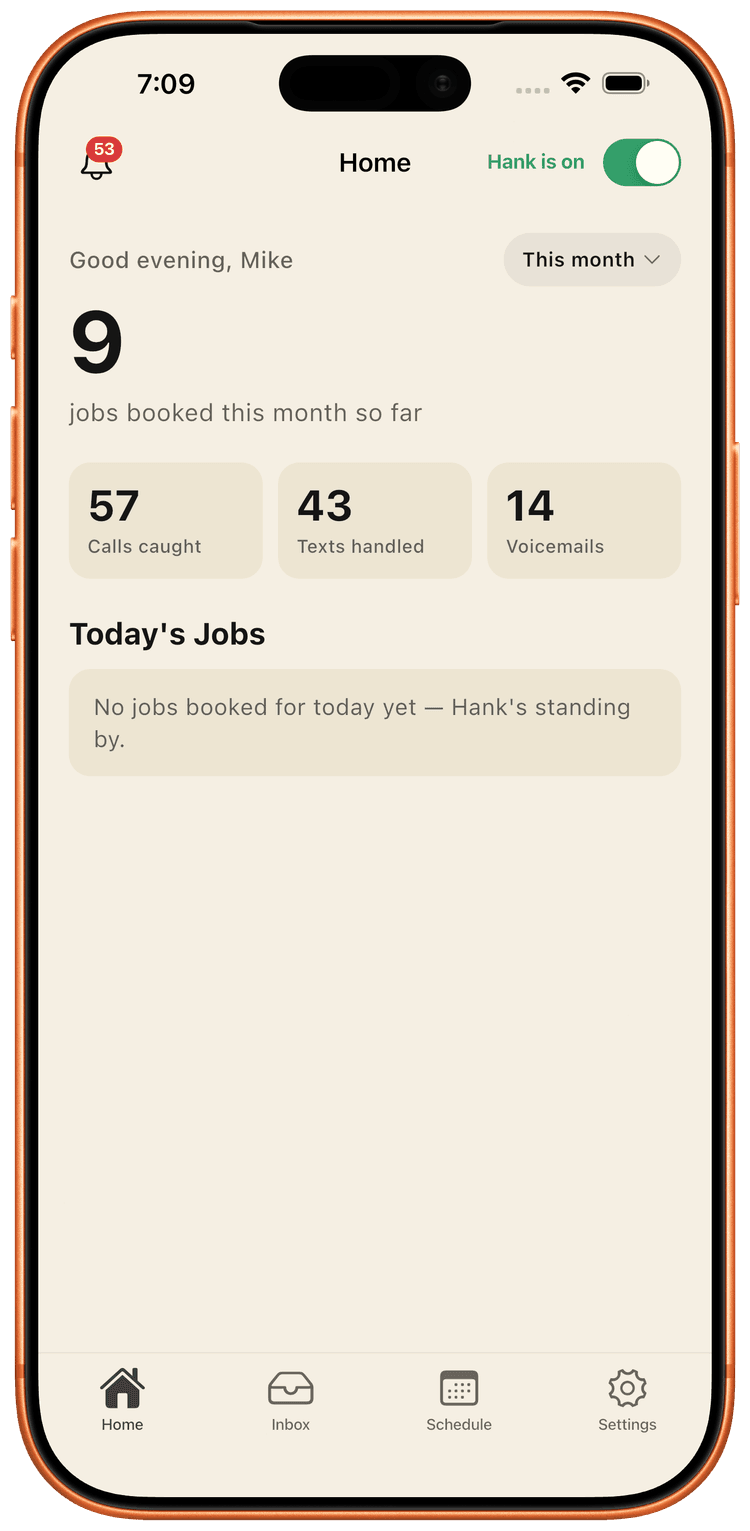
We built Hank as an AI answering service for trade shops. The 'answering service' label fits our actual function (we answer your phone, qualify the work, book the job). The 'AI for trades' part is what makes us different from generic services.
If you're in the 'answering service vs virtual receptionist' question, the more useful question is: which of the five things above (trade fluency, dispatch integration, billing, after-hours, script speed) is your shop bottlenecked on right now? Then evaluate options against that.
Stop missing the calls.
Free for 30 days, then $149/mo. Set up yourself in about 5 minutes — we’ll walk you through it if you want.
Get hank on your line